
How AI is Reshaping Work and Human Psychology
By Paul Tsagaroulis, PhD
Picture this: You log in on Monday morning, and the report that used to take three hours is already complete. An AI assistant compiled, formatted, analyzed, and distributed your report. You have more time for creative thinking, problem solving, strategic projects, or to catch your breath. Later, you wonder whether the AI-generated report is correct. In meetings, you hesitate to suggest new ideas, unsure whether your manager and your coworkers will judge them. You are uncertain about your role altogether and wonder if AI could make your job obsolete. This tension between AI’s benefits and risks highlights a paradox in the workplace. While technology can enhance the work experience, it can also diminish it.
AI is changing how we work and how we experience work. While AI is already transforming work processes, emerging evidence shows it is also reshaping the psychological experience of work. Two theories that could be helpful to understand how AI transformations are reshaping how we experience work are psychological well-being and psychological safety. Neglecting these psychological dimensions can lead to unintended consequences, creating a strategic imperative that organizations must address.
The Core Challenge
Central to this workplace transformation is how AI affects our fundamental human need for connection. The U.S. Surgeon General’s 2023 declaration of loneliness as a public health crisis becomes increasingly urgent in workplace contexts (OSG, 2023; SIOP, 2024). Research reveals a troubling pathway: AI adoption can reduce psychological well-being and safety, yet AI can also strengthen workplace connections when implemented thoughtfully. This dual nature requires organizations to move beyond efficiency metrics and address the human experience directly. The central question emerges: How do we promote psychological well-being and safety while maximizing AI’s transformative potential?
The Psychological Paradox of AI Workplace Transformation
AI’s influence on human psychology presents a complex duality. On one hand, AI can strengthen psychological well-being by relieving people of repetitive tasks and allowing them to focus on more meaningful, creative work. Psychological well-being includes a sense of autonomy, mastery, purpose, and growth (Ryff, 1989), elements that AI has the potential to enhance.
On the other hand, AI can undermine the very foundations of workplace satisfaction. Research demonstrates that AI adoption can reduce psychological safety, which is the shared belief that it’s safe to speak up, take risks, and make mistakes without fear of punishment (Edmondson, 1999). A recent study reveals a troubling pathway: AI adoption reduces psychological safety, which significantly increases depression risk among employees (Kim et al., 2025).
The stakes are clear. When implemented without psychological consideration, AI can increase stress, contribute to workplace loneliness, and weaken the connections that make work fulfilling (Calm, 2024; De Cremer & Koopman, 2024). However, when implemented thoughtfully, AI can strengthen rather than weaken workplace relationships (McCarthy et al., 2025).
From Workplace Changes to Psychological Adaptation
AI is transforming workplaces more rapidly than the internet or personal computers ever did (Gokani & Janke, 2025). Rather than eliminating jobs, AI is reshaping work itself, creating new specialized roles where machines handle routine digital tasks while humans contribute creativity, emotional intelligence, and complex reasoning (Burtch Works Team, 2024; Dunderdale, 2024). This workplace evolution triggers predictable psychological responses. Research on technology acceptance shows that people progress through distinct stages: initial resistance based on uncertainty, gradual experimentation as usefulness becomes apparent, and eventual integration when experience builds confidence (Venkatesh et al., 2003). Understanding this emotional journey is crucial for successful AI implementation.
The key insight? Organizations cannot simply deploy AI and expect positive adaptation. Leaders must actively create conditions that support psychological progression. This requires focusing on two interconnected foundations: psychological safety enables the experimentation necessary for learning, while meaningful work motivates to engage with new tools and processes.
Redefining Work Productivity Through AI
Understanding how to create these conditions requires examining what effective AI-human collaboration looks like in practice. AI’s potential extends beyond efficiency to reallocating human cognitive resources toward tasks that align with individual preferences and professional identities. The Harvard Business School study by Hoffman et. al. (2025) of GitHub Copilot provides compelling evidence. When developers gained AI coding assistance, they spent significantly more time on actual coding–their preferred activity–and less time on meetings and administrative tasks. This reallocation improved both productivity and job satisfaction.
However, AI benefits diminish with task complexity. Research reveals a crucial caveat: these benefits decrease significantly as task complexity increases, often requiring rework that negates improvements (Denisov-Blanch, 2025). This finding illuminates a critical design principle. AI works best when it handles well-defined, routine elements–this frees humans for ambiguous, creative, and relationship-intensive work.
To operationalize this principle, organizations need a systematic approach to AI deployment decisions. Leaders can use this complexity spectrum to make strategic AI deployment decisions, identifying which tasks benefit from AI automation versus human expertise (Figure 1):
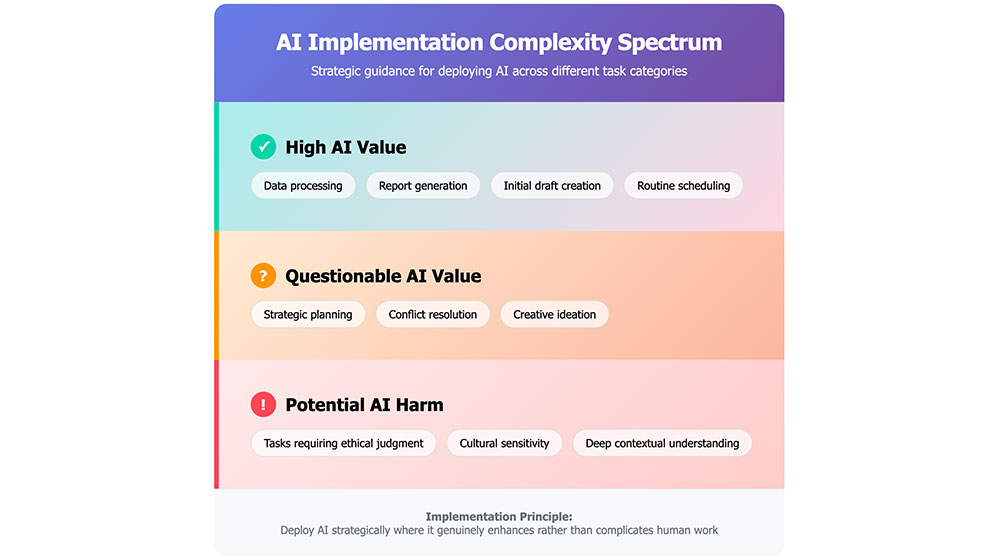
Figure 1. AI Implementation Complexity Spectrum
Building Psychological Safety for AI Innovation
Creating psychologically safe AI experimentation requires addressing four fundamental employee needs during transformation: security (Will I retain value?), agency (Do I maintain control?), connection (Will I belong?), and purpose (Does my work matter?). These needs align with Deci and Ryan’s self-determination theory (1985, 2000), which identifies autonomy, competence, and relatedness as the psychological foundations for motivation, engagement, and resilience during change. When these needs are met, individuals experience intrinsic motivation, enhanced performance, and greater psychological resilience during periods of organizational change.
Organizations that systematically address these four needs create the psychological conditions necessary for successful AI adoption. Employees who feel secure in their value, connected to their colleagues, empowered to make choices, and clear about their purpose are more likely to view AI as an enhancement tool rather than a threat. This psychological foundation becomes the catalyst for innovation, experimentation, and collaborative human-AI relationships.
When psychological safety exists, remarkable outcomes emerge. Hoffman et. al. (2025) revealed that developers with lower initial ability benefited more from AI assistance than top performers, suggesting AI can democratize workplace success when employees feel safe to experiment without judgment.
AI’s Expanding Personal and Professional Influence
While organizations focus on building psychological safety for workplace AI adoption, employees are already embracing AI in deeply personal ways. Zao-Sanders’ (2025) research reveals that therapy and companionship represent the top AI applications, indicating a shift toward personal support (Figure 2). This trend exemplifies the central paradox: while AI provides valuable emotional resources, it may reshape how we seek human support in professional settings.
When employees become comfortable using AI for personal emotional support, they may approach workplace AI tools with less anxiety and greater openness to experimentation. This personal-professional AI spillover creates both opportunities and responsibilities for leaders. Building comfort with AI in low-stakes personal contexts can increase receptivity to workplace AI collaboration, but organizations must ensure AI supports rather than replaces meaningful human connections.
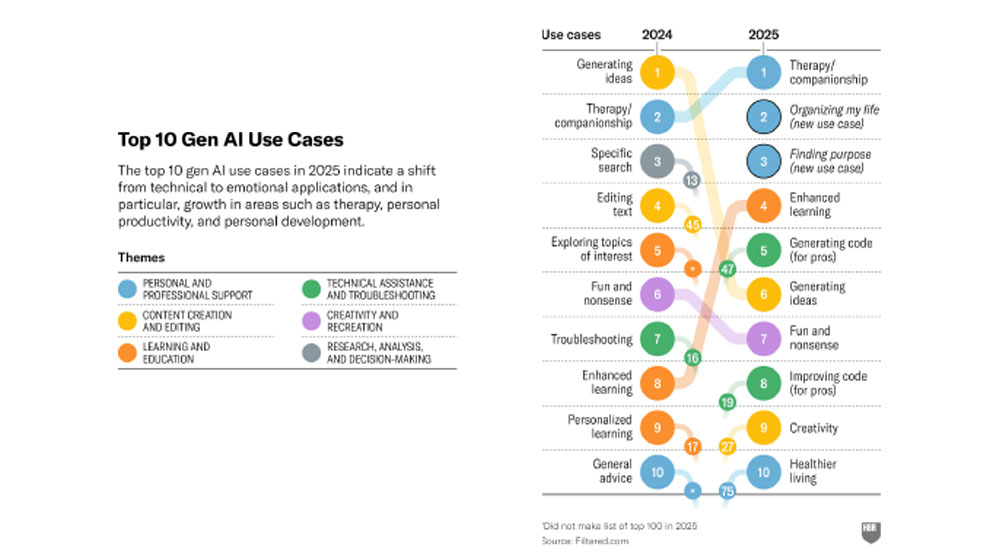
Figure 2. Top 10 Gen AI Use Cases
This spillover effect requires a dual approach. As individuals, we need to strengthen the uniquely human skills that complement AI: creative problem-solving, emotional intelligence, ethical reasoning, and understanding nuance. Organizations must simultaneously ensure that workplace AI implementations enhance rather than replace the human connections that drive collaboration and innovation.
The question isn’t whether employees will use AI personally. They already are. The question is how organizations can leverage this growing comfort to accelerate positive workplace adoption while preserving essential human connections.
Given the complex interplay between personal AI adoption and workplace psychology, leaders need a systematic approach to implementation. The following framework addresses both the operational and experiential dimensions of AI transformation.
Recommendations for Leaders: A Strategic Framework
Transforming work processes (how we work):
- Create guidelines that preserve employee autonomy.
- Roll out AI gradually with continuous feedback loops.
- Cultivate psychological safety for AI experimentation.
- Provide confidence-building AI literacy training.
- Establish “AI-optional” zones for voluntary engagement.
Enhancing work experiences (how we experience work):
- Design AI implementations that strengthen human connections.
- Achieve productivity gains while actively promoting wellbeing.
- Redirect AI-freed time toward meaningful, human-centered activities.
- Foster communities of practice for sharing AI experiences.
- Regularly assess the four fundamental needs: security, agency, connection, and purpose.
Implementation Phases
While these recommendations provide a comprehensive framework, successful implementation requires careful sequencing. While implementation timelines vary by organization, rushing through the Foundation phase often undermines long-term success. And remember, building psychological safety is not a one-time effort but a progressive journey (Figure 3). Leaders should sequence their AI implementation in three strategic phases:
- Foundation: Create psychological safety for AI exploration (establish trust, address fears, communicate purpose).
- Experimentation: Cultivate skills and gradual AI adoption (pilot programs, training, feedback collection).
- Integration: Enhance relationships and monitor employee wellbeing (scale successful practices, measure psychological outcomes).
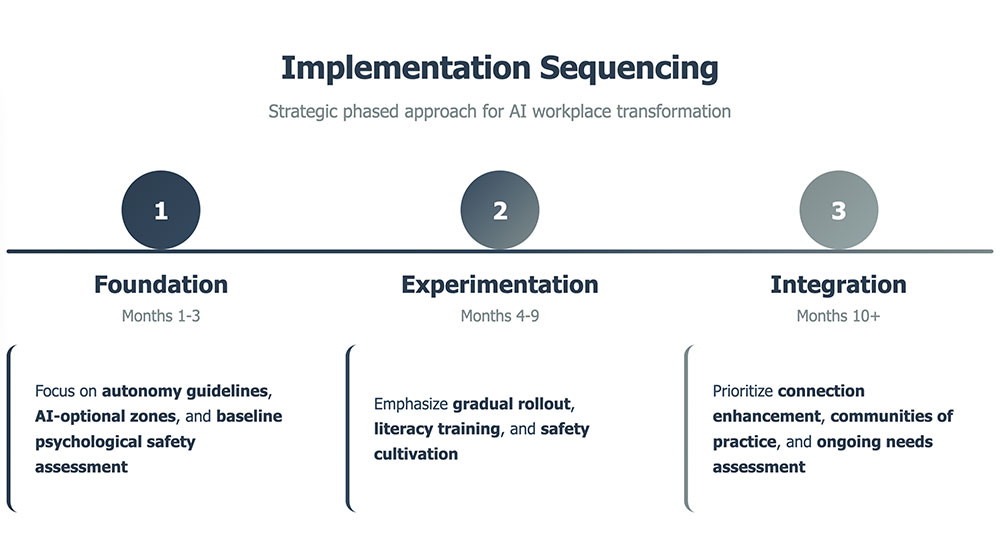
Figure 3. Implementation Sequencing
Conclusion
The worker who logged in on Monday morning, wondering about AI’s impact on their role, represents millions of workers facing this transformation. Given AI’s transformative impact, successful transformation requires intentional design that prioritizes human psychology alongside technological capability. This requires acknowledging AI’s dual nature as both enabler and disruptor, then systematically building human-centered implementation approaches. Organizations that address the psychological dimensions of AI transformation, particularly psychological safety and meaningful work, will create environments where people do not just work with AI, but can thrive with it.
By understanding the emotional journey of AI adoption and addressing fundamental psychological needs, leaders can harness AI’s potential while preserving the human connections and sense of purpose that makes work fulfilling. The organizations that succeed will be those that treat AI as a catalyst for human potential: designing implementations that amplify rather than replace human judgment, creativity, and connection. This human-centered approach to AI isn’t just ethically sound; it’s strategically essential for sustainable competitive advantage.
References
- Burtch Works Team. (2024). The rise of AI: Specialization, salaries, and future trends. AI Edge. Link
- Calm. (2024). 2024 Voice of the Workplace Report. Link
- Deci, E. L., & Ryan, R. M. (1985). Intrinsic motivation and self-determination in human behavior. Plenum Press. Link
- Deci, E. L., & Ryan, R. M. (2000). The “what” and “why” of goal pursuits: Human needs and the self-determination of behavior. Psychological Inquiry, 11(4), 227-268. Link
- De Cremer, D., Koopman, J. (2024). Research: Using AI at work makes us lonelier and less healthy. Harvard Business Review. Link
- Denisov-Blanch, B. (2025). Does AI actually boost developer productivity? YouTube. Link
- Dunderdale, R. (2024). The impact of AI on the future of work. AI Edge. Link
- Edmondson, A. (1999). Psychological safety and learning behavior in work teams. Administrative Science Quarterly, 44(2), 350-383. Link
- Gokani, H., & Janke, A. (2025). AI revolution: Will jobs be replaced or merely changed forever? AI Edge. Link
- Hoffman, M., Boysel, S., Nagle, F., Peng, S., & Xu, K. (2025). Generative AI and the nature of work (Working Paper No. 25-021). Harvard Business School. Link
- Kim, BJ., Kim, MJ., & Lee, J. (2025). The dark side of artificial intelligence adoption: Linking artificial intelligence adoption to employee depression via psychological safety and ethical leadership. Humanities and Social Science Communications, 12(704). Link
- McCarthy, J. M., Erdogan, B., Bauer, T. N., Kudret, S., & Campion, E. (2025). All the Lonely People: An Integrated Review and Research Agenda on Work and Loneliness. Journal of Management, 0(0). Link
- Office of the Surgeon General (OSG). (2023). Our epidemic of loneliness and isolation: The U.S. Surgeon General’s advisory on the healing effects of social connection and community. U.S. Department of Health and Human Services. Link
- Ryff, C. D. (1989). Happiness is everything, or is it? Explorations on the meaning of psychological well-being. Journal of Personality and Social Psychology, 57(6), 1069–1081. Link
- SIOP. (2024). More than a job: Why the workplace matters for human connection. Society for Industrial and Organizational Psychology. Link
- Venkatesh, V., Morris, M. G., Davis, G. B., & Davis, F. D. (2003). User acceptance of information technology: Toward a unified view. MIS Quarterly, 27(3), 425-478. Link
- Zao-Sanders, M. (2025). How people are really using gen AI in 2025. Harvard Business Review. Link

About the author
Paul Tsagaroulis is an industrial-organizational psychologist. He is the director of people analytics at the University of Virginia and has a PhD in business psychology from The Chicago School.
By Paul Tsagaroulis, PhD
Picture this: You log in on Monday morning, and the report that used to take three hours is already complete. An AI assistant compiled, formatted, analyzed, and distributed your report. You have more time for creative thinking, problem solving, strategic projects, or to catch your breath. Later, you wonder whether the AI-generated report is correct. In meetings, you hesitate to suggest new ideas, unsure whether your manager and your coworkers will judge them. You are uncertain about your role altogether and wonder if AI could make your job obsolete. This tension between AI’s benefits and risks highlights a paradox in the workplace. While technology can enhance the work experience, it can also diminish it.
AI is changing how we work and how we experience work. While AI is already transforming work processes, emerging evidence shows it is also reshaping the psychological experience of work. Two theories that could be helpful to understand how AI transformations are reshaping how we experience work are psychological well-being and psychological safety. Neglecting these psychological dimensions can lead to unintended consequences, creating a strategic imperative that organizations must address.
The Core Challenge
Central to this workplace transformation is how AI affects our fundamental human need for connection. The U.S. Surgeon General’s 2023 declaration of loneliness as a public health crisis becomes increasingly urgent in workplace contexts (OSG, 2023; SIOP, 2024). Research reveals a troubling pathway: AI adoption can reduce psychological well-being and safety, yet AI can also strengthen workplace connections when implemented thoughtfully. This dual nature requires organizations to move beyond efficiency metrics and address the human experience directly. The central question emerges: How do we promote psychological well-being and safety while maximizing AI’s transformative potential?
The Psychological Paradox of AI Workplace Transformation
AI’s influence on human psychology presents a complex duality. On one hand, AI can strengthen psychological well-being by relieving people of repetitive tasks and allowing them to focus on more meaningful, creative work. Psychological well-being includes a sense of autonomy, mastery, purpose, and growth (Ryff, 1989), elements that AI has the potential to enhance.
On the other hand, AI can undermine the very foundations of workplace satisfaction. Research demonstrates that AI adoption can reduce psychological safety, which is the shared belief that it’s safe to speak up, take risks, and make mistakes without fear of punishment (Edmondson, 1999). A recent study reveals a troubling pathway: AI adoption reduces psychological safety, which significantly increases depression risk among employees (Kim et al., 2025).
The stakes are clear. When implemented without psychological consideration, AI can increase stress, contribute to workplace loneliness, and weaken the connections that make work fulfilling (Calm, 2024; De Cremer & Koopman, 2024). However, when implemented thoughtfully, AI can strengthen rather than weaken workplace relationships (McCarthy et al., 2025).
From Workplace Changes to Psychological Adaptation
AI is transforming workplaces more rapidly than the internet or personal computers ever did (Gokani & Janke, 2025). Rather than eliminating jobs, AI is reshaping work itself, creating new specialized roles where machines handle routine digital tasks while humans contribute creativity, emotional intelligence, and complex reasoning (Burtch Works Team, 2024; Dunderdale, 2024). This workplace evolution triggers predictable psychological responses. Research on technology acceptance shows that people progress through distinct stages: initial resistance based on uncertainty, gradual experimentation as usefulness becomes apparent, and eventual integration when experience builds confidence (Venkatesh et al., 2003). Understanding this emotional journey is crucial for successful AI implementation.
The key insight? Organizations cannot simply deploy AI and expect positive adaptation. Leaders must actively create conditions that support psychological progression. This requires focusing on two interconnected foundations: psychological safety enables the experimentation necessary for learning, while meaningful work motivates to engage with new tools and processes.
Redefining Work Productivity Through AI
Understanding how to create these conditions requires examining what effective AI-human collaboration looks like in practice. AI’s potential extends beyond efficiency to reallocating human cognitive resources toward tasks that align with individual preferences and professional identities. The Harvard Business School study by Hoffman et. al. (2025) of GitHub Copilot provides compelling evidence. When developers gained AI coding assistance, they spent significantly more time on actual coding–their preferred activity–and less time on meetings and administrative tasks. This reallocation improved both productivity and job satisfaction.
However, AI benefits diminish with task complexity. Research reveals a crucial caveat: these benefits decrease significantly as task complexity increases, often requiring rework that negates improvements (Denisov-Blanch, 2025). This finding illuminates a critical design principle. AI works best when it handles well-defined, routine elements–this frees humans for ambiguous, creative, and relationship-intensive work.
To operationalize this principle, organizations need a systematic approach to AI deployment decisions. Leaders can use this complexity spectrum to make strategic AI deployment decisions, identifying which tasks benefit from AI automation versus human expertise (Figure 1):
Building Psychological Safety for AI Innovation
Creating psychologically safe AI experimentation requires addressing four fundamental employee needs during transformation: security (Will I retain value?), agency (Do I maintain control?), connection (Will I belong?), and purpose (Does my work matter?). These needs align with Deci and Ryan’s self-determination theory (1985, 2000), which identifies autonomy, competence, and relatedness as the psychological foundations for motivation, engagement, and resilience during change. When these needs are met, individuals experience intrinsic motivation, enhanced performance, and greater psychological resilience during periods of organizational change.
Organizations that systematically address these four needs create the psychological conditions necessary for successful AI adoption. Employees who feel secure in their value, connected to their colleagues, empowered to make choices, and clear about their purpose are more likely to view AI as an enhancement tool rather than a threat. This psychological foundation becomes the catalyst for innovation, experimentation, and collaborative human-AI relationships.
When psychological safety exists, remarkable outcomes emerge. Hoffman et. al. (2025) revealed that developers with lower initial ability benefited more from AI assistance than top performers, suggesting AI can democratize workplace success when employees feel safe to experiment without judgment.
AI’s Expanding Personal and Professional Influence
While organizations focus on building psychological safety for workplace AI adoption, employees are already embracing AI in deeply personal ways. Zao-Sanders’ (2025) research reveals that therapy and companionship represent the top AI applications, indicating a shift toward personal support (Figure 2). This trend exemplifies the central paradox: while AI provides valuable emotional resources, it may reshape how we seek human support in professional settings.
When employees become comfortable using AI for personal emotional support, they may approach workplace AI tools with less anxiety and greater openness to experimentation. This personal-professional AI spillover creates both opportunities and responsibilities for leaders. Building comfort with AI in low-stakes personal contexts can increase receptivity to workplace AI collaboration, but organizations must ensure AI supports rather than replaces meaningful human connections.
This spillover effect requires a dual approach. As individuals, we need to strengthen the uniquely human skills that complement AI: creative problem-solving, emotional intelligence, ethical reasoning, and understanding nuance. Organizations must simultaneously ensure that workplace AI implementations enhance rather than replace the human connections that drive collaboration and innovation.
The question isn’t whether employees will use AI personally. They already are. The question is how organizations can leverage this growing comfort to accelerate positive workplace adoption while preserving essential human connections.
Given the complex interplay between personal AI adoption and workplace psychology, leaders need a systematic approach to implementation. The following framework addresses both the operational and experiential dimensions of AI transformation.
Recommendations for Leaders: A Strategic Framework
Transforming work processes (how we work):
- Create guidelines that preserve employee autonomy.
- Roll out AI gradually with continuous feedback loops.
- Cultivate psychological safety for AI experimentation.
- Provide confidence-building AI literacy training.
- Establish “AI-optional” zones for voluntary engagement.
Enhancing work experiences (how we experience work):
- Design AI implementations that strengthen human connections.
- Achieve productivity gains while actively promoting wellbeing.
- Redirect AI-freed time toward meaningful, human-centered activities.
- Foster communities of practice for sharing AI experiences.
- Regularly assess the four fundamental needs: security, agency, connection, and purpose.
Implementation Phases
While these recommendations provide a comprehensive framework, successful implementation requires careful sequencing. While implementation timelines vary by organization, rushing through the Foundation phase often undermines long-term success. And remember, building psychological safety is not a one-time effort but a progressive journey (Figure 3). Leaders should sequence their AI implementation in three strategic phases:
- Foundation: Create psychological safety for AI exploration (establish trust, address fears, communicate purpose).
- Experimentation: Cultivate skills and gradual AI adoption (pilot programs, training, feedback collection).
- Integration: Enhance relationships and monitor employee wellbeing (scale successful practices, measure psychological outcomes).
Conclusion
The worker who logged in on Monday morning, wondering about AI’s impact on their role, represents millions of workers facing this transformation. Given AI’s transformative impact, successful transformation requires intentional design that prioritizes human psychology alongside technological capability. This requires acknowledging AI’s dual nature as both enabler and disruptor, then systematically building human-centered implementation approaches. Organizations that address the psychological dimensions of AI transformation, particularly psychological safety and meaningful work, will create environments where people do not just work with AI, but can thrive with it.
By understanding the emotional journey of AI adoption and addressing fundamental psychological needs, leaders can harness AI’s potential while preserving the human connections and sense of purpose that makes work fulfilling. The organizations that succeed will be those that treat AI as a catalyst for human potential: designing implementations that amplify rather than replace human judgment, creativity, and connection. This human-centered approach to AI isn’t just ethically sound; it’s strategically essential for sustainable competitive advantage.
References
- Burtch Works Team. (2024). The rise of AI: Specialization, salaries, and future trends. AI Edge. Link
- Calm. (2024). 2024 Voice of the Workplace Report. Link
- Deci, E. L., & Ryan, R. M. (1985). Intrinsic motivation and self-determination in human behavior. Plenum Press. Link
- Deci, E. L., & Ryan, R. M. (2000). The “what” and “why” of goal pursuits: Human needs and the self-determination of behavior. Psychological Inquiry, 11(4), 227-268. Link
- De Cremer, D., Koopman, J. (2024). Research: Using AI at work makes us lonelier and less healthy. Harvard Business Review. Link
- Denisov-Blanch, B. (2025). Does AI actually boost developer productivity? YouTube. Link
- Dunderdale, R. (2024). The impact of AI on the future of work. AI Edge. Link
- Edmondson, A. (1999). Psychological safety and learning behavior in work teams. Administrative Science Quarterly, 44(2), 350-383. Link
- Gokani, H., & Janke, A. (2025). AI revolution: Will jobs be replaced or merely changed forever? AI Edge. Link
- Hoffman, M., Boysel, S., Nagle, F., Peng, S., & Xu, K. (2025). Generative AI and the nature of work (Working Paper No. 25-021). Harvard Business School. Link
- Kim, BJ., Kim, MJ., & Lee, J. (2025). The dark side of artificial intelligence adoption: Linking artificial intelligence adoption to employee depression via psychological safety and ethical leadership. Humanities and Social Science Communications, 12(704). Link
- McCarthy, J. M., Erdogan, B., Bauer, T. N., Kudret, S., & Campion, E. (2025). All the Lonely People: An Integrated Review and Research Agenda on Work and Loneliness. Journal of Management, 0(0). Link
- Office of the Surgeon General (OSG). (2023). Our epidemic of loneliness and isolation: The U.S. Surgeon General’s advisory on the healing effects of social connection and community. U.S. Department of Health and Human Services. Link
- Ryff, C. D. (1989). Happiness is everything, or is it? Explorations on the meaning of psychological well-being. Journal of Personality and Social Psychology, 57(6), 1069–1081. Link
- SIOP. (2024). More than a job: Why the workplace matters for human connection. Society for Industrial and Organizational Psychology. Link
- Venkatesh, V., Morris, M. G., Davis, G. B., & Davis, F. D. (2003). User acceptance of information technology: Toward a unified view. MIS Quarterly, 27(3), 425-478. Link
- Zao-Sanders, M. (2025). How people are really using gen AI in 2025. Harvard Business Review. Link